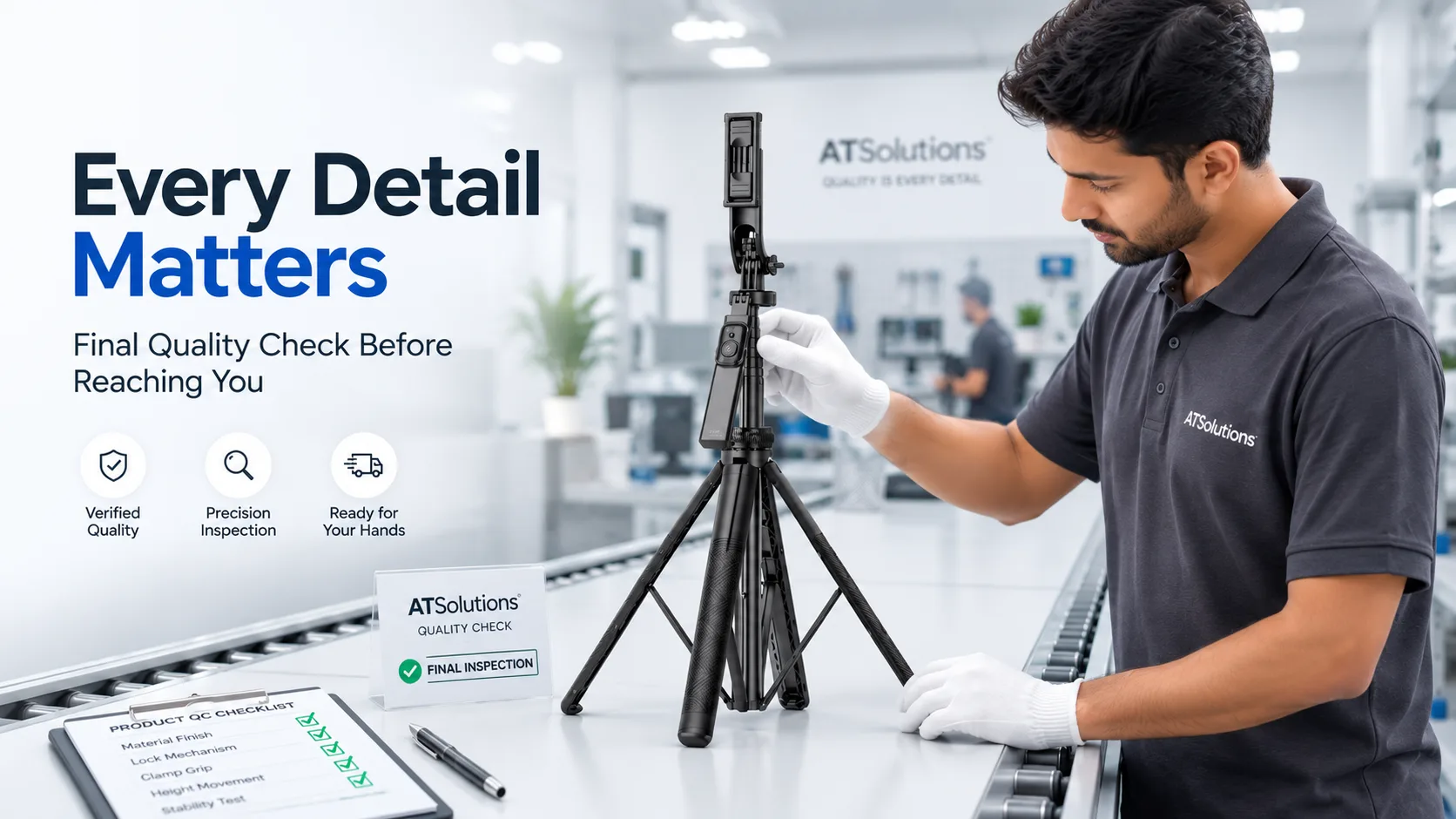
You've probably had a cheap tripod fail on you before. Maybe the legs wobbled mid-shoot, or the phone clamp snapped after a month. It's a common problem — and it's exactly why quality control matters more than the spec sheet.
At ATSolutions, every mobile tripod goes through a structured quality check process before it ever reaches a customer. Here's what that actually looks like, check by check, so you know what you're paying for.
ATSolutions mobile tripods pass through 10 checkpoints — material inspection, load and stability testing, leg-lock durability, ball-head smoothness, clamp grip strength, height and angle range, packaging drop tests, finish inspection, functional re-test, and final QA sign-off — before any unit ships.
1. Raw Material Inspection
Before assembly even starts, the aluminum alloy or reinforced ABS used for the legs and center column gets checked for consistency. Weak or inconsistent material is the root cause of most tripod failures later — cracked legs, stripped threads, brittle locks. Catching a bad batch here is far cheaper than a return six weeks later.
2. Load-Bearing and Stability Testing
Each tripod design is tested with weight well above its rated capacity — usually simulating a phone plus an external mic or ring light, not just a bare phone. The tripod has to hold that load without leg splay or tipping on a flat, even a slightly uneven, surface.
Why it matters: most "tripod fell over" complaints happen because the tripod was rated for a phone alone, not the accessories people actually mount.
3. Leg-Lock and Extension Durability
Flip locks and twist locks get cycled dozens of times — extended, locked, collapsed, repeat — to make sure they don't loosen or strip. A lock that feels fine on day one but slips by week three is a design flaw, not bad luck, and this is the stage meant to catch it.
4. Ball-Head and Pan Mechanism Smoothness
The ball head (or pan-tilt head, depending on the model) is tested for smooth, controlled movement without sudden drops. If it locks in place with a firm twist but doesn't slip under normal handling, it passes. Gritty or jerky movement gets flagged and the batch is reworked.
5. Phone Clamp Grip Strength
The clamp is tested across a range of phone widths and weights, including heavier phones in thick cases. It needs to hold firmly without over-compressing (which can crack a case) or under-gripping (which risks the phone sliding out mid-shot).
6. Height and Angle Range Verification
Every model is checked against its listed specs — minimum height, maximum height, and the full tilt/rotation range. If the listing says 360° rotation or a specific height range, this check confirms the actual unit matches, not just the prototype.
7. Packaging Drop Test
Tripods get bumped and dropped in transit more than people expect. Units are boxed and drop-tested from typical shipping heights to make sure the packaging — not just the product — protects against dents, bent legs, or a cracked head mechanism before it even reaches your door.
8. Finish and Cosmetic Inspection
This one's less about function, more about first impression: checking for uneven coating, sharp edges, misaligned logos, or scratches from handling. A tripod can pass every mechanical test and still feel cheap if the finish is inconsistent.
9. Functional Re-Test After Assembly
After final assembly, a sample from each batch is re-tested end-to-end — extend, lock, mount a phone, adjust angle, collapse — to catch anything that slipped through individual-component checks but shows up only once everything's put together.
10. Final QA Sign-Off
The last checkpoint is a manual sign-off against a checklist covering all nine previous steps. Nothing ships without this. It's the difference between "probably fine" and "confirmed fine."
Common Mistakes Buyers Make When Judging Tripod Quality
- Trusting the photos alone. A tripod can look identical to a premium one in a listing photo and still use thinner-gauge aluminum underneath.
- Ignoring the clamp spec. Buyers check height range but skip the max phone width/weight — then wonder why their phone-plus-case combo doesn't fit securely.
- Assuming heavier means sturdier. Weight isn't the same as stability. A well-designed lightweight tripod can outperform a heavy, poorly balanced one.
- Skipping the lock-cycle question. Most people don't think to ask how many times a lock has been tested to hold before it loosens — but that's usually the first part to fail.
What This Means for You
Pros of a checkpoint-based QC process:
- Fewer early failures (wobble, slipping clamps, stripped locks)
- Specs on the listing actually match the unit you receive
- Packaging failures caught before they become "arrived damaged" complaints
Trade-offs worth knowing:
- A rigorous QC process adds cost, so heavily discounted no-name tripods often skip several of these steps entirely
- No QC process eliminates 100% of defects — sampling-based re-testing (step 9) catches most, not all, issues, which is why a fair return policy still matters
Expert Tips for Choosing a Reliable Mobile Tripod
- Check the clamp's stated max phone width with a case on, not just the phone alone.
- Look for a stated load capacity that's higher than "one phone" — you'll likely add a light or mic eventually.
- Test the lock mechanism yourself within the return window: extend and collapse it 15–20 times. If it's already loosening, it will only get worse.
- Favor tripods with a stated rotation/tilt range over vague terms like "flexible angles."
Final Thoughts
A tripod's real test isn't the unboxing — it's month three, when the locks have been cycled a hundred times and the clamp's held a dozen different phones. That's what a structured QC process is actually protecting against.
If you're comparing tripods, don't just read the spec sheet — ask what happens before the product ships. That's usually where the real difference between "cheap" and "reliable" gets decided.
Curious how an ATSolutions tripod holds up for your specific setup? Take a look at the current lineup and match one to your phone and accessory weight before you buy.